Choosing the Perfect Thread Color for Quilting
Choosing the perfect thread color for quilting doesn’t have to be complicated but it can absolutely feel that way. There are so many thread choices, you want to pick the right one.
Walk into a quilt shop and suddenly you’re staring at a wall of thread in every shade imaginable. Do you match the fabric? The background? The backing? Should it be lighter? Darker? Cotton? Polyester?
Let’s simplify this.
Here’s the truth: most of choosing thread color for quilting is personal preference. But there are a few practical guidelines that will save you from second-guessing every quilt you make.
We’ll cover:
- What color thread goes with everything
- Whether thread should be lighter or darker than fabric
- The top 3 most popular quilting thread colors
- How to choose the right thread color
- Cotton vs. polyester thread
- The best cotton quilting thread brands and where to buy them
MAKE SURE YOU CHECK THIS OUT!
Grab a copy of my free Quilt Planning Journal. It’s filled with graph paper and note pages to help you design at least 4 quilt or sewing projects! Pin in fabric swatches, photos of your finished quilts and enjoy your creative process!
Choosing the Perfect Thread Color for Quilting
Thread for Sewing the Quilt Top vs. Thread for Machine Quilting
Let me say this upfront:
I hate changing my thread color.
The more you change thread, the more you rethread your machine, adjust tension, second-guess your choice, and slow yourself down. Quilting should not feel like a thread management competition.
So here’s how I keep it simple.
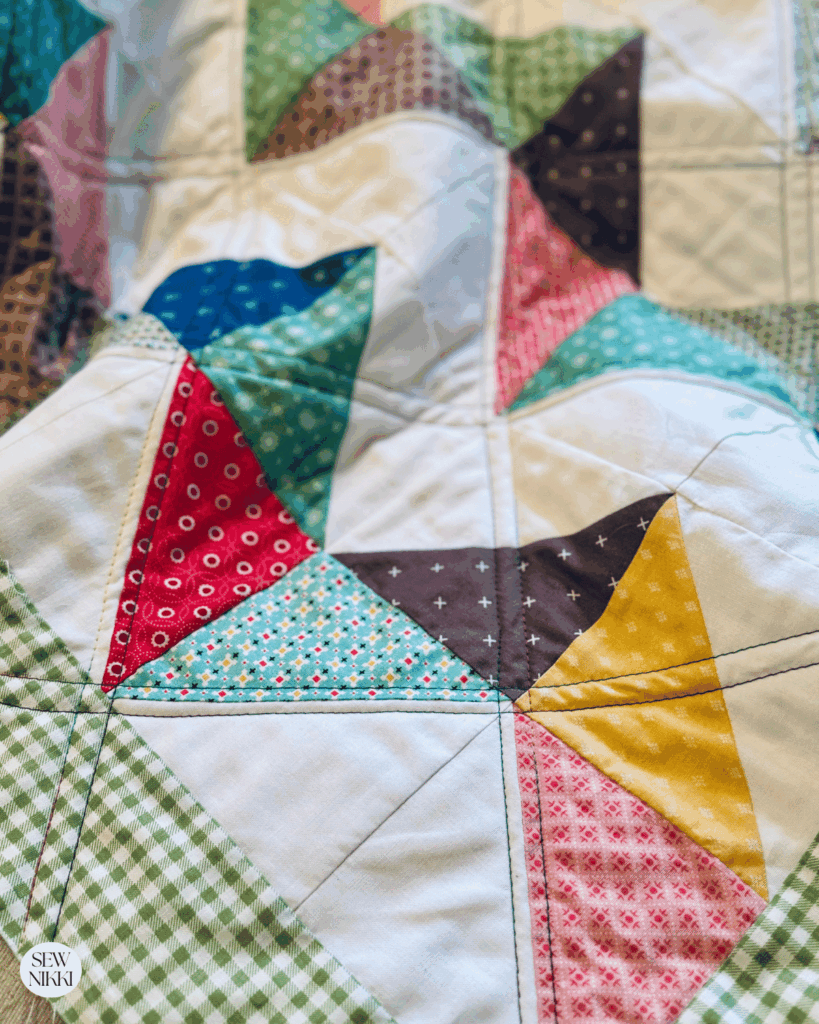
What I Use for Sewing the Quilt Top (Piecing)
When I’m piecing a quilt top, I use a light neutral thread.
Most of the time that means:
- White 100% cotton thread
- Sometimes soft gray
- Sometimes light beige
And I never piece a quilt top with a dark thread.
Ever.
Why? Because dark thread can shadow through lighter fabrics and sometimes even show along seam lines. You run the risk of little specks or shadows appearing where you don’t want them — and once it’s stitched into your seams, it’s not easy to fix.
Piecing thread lives inside seam allowances. It doesn’t need to make a statement. It just needs to hold everything together cleanly and invisibly.
Light neutral thread keeps things safe.
Whatever light shade I start with for piecing — white, dove gray, or light beige — I keep it in the machine.
I do not swap it out just because I’m moving to the quilting stage.
What I Use for Machine Quilting
Most of the time?
I use the exact same thread that I used for piecing.
If I pieced with white, I quilt with white.
Pieced with soft gray, I quilt with soft gray.
If I pieced with light beige, I quilt with light beige.
Done.
This removes:
- Extra thread changes
- Decision fatigue
- Tension readjustments
- “Did I pick the right shade?” spirals
Now, if I’m working on a bright, scrappy quilt with lots of bold colors?
That’s when I’ll grab my multi-colored thread for machine quilting. It blends beautifully across color changes and adds movement without overpowering the quilt.
But even then I’m not overthinking it.
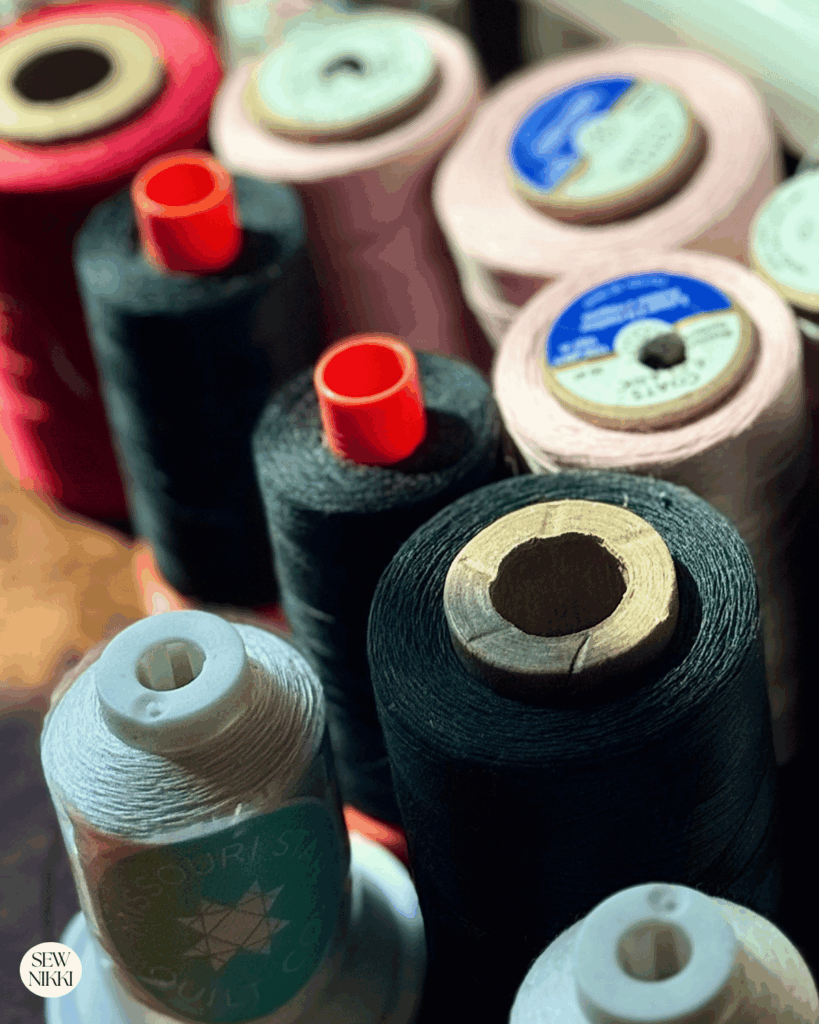
What About Thread Weight?
I don’t stress about thread weight.
If I want the quilting lines to show up more, I might switch to a slightly heavier weight for more definition but I’ll just use that same weight for piecing too.
Again: fewer changes.
The goal isn’t managing five different spools at every stage. The goal is finishing quilts without turning simple decisions into complicated ones.
The 3 Thread Colors I Actually Use
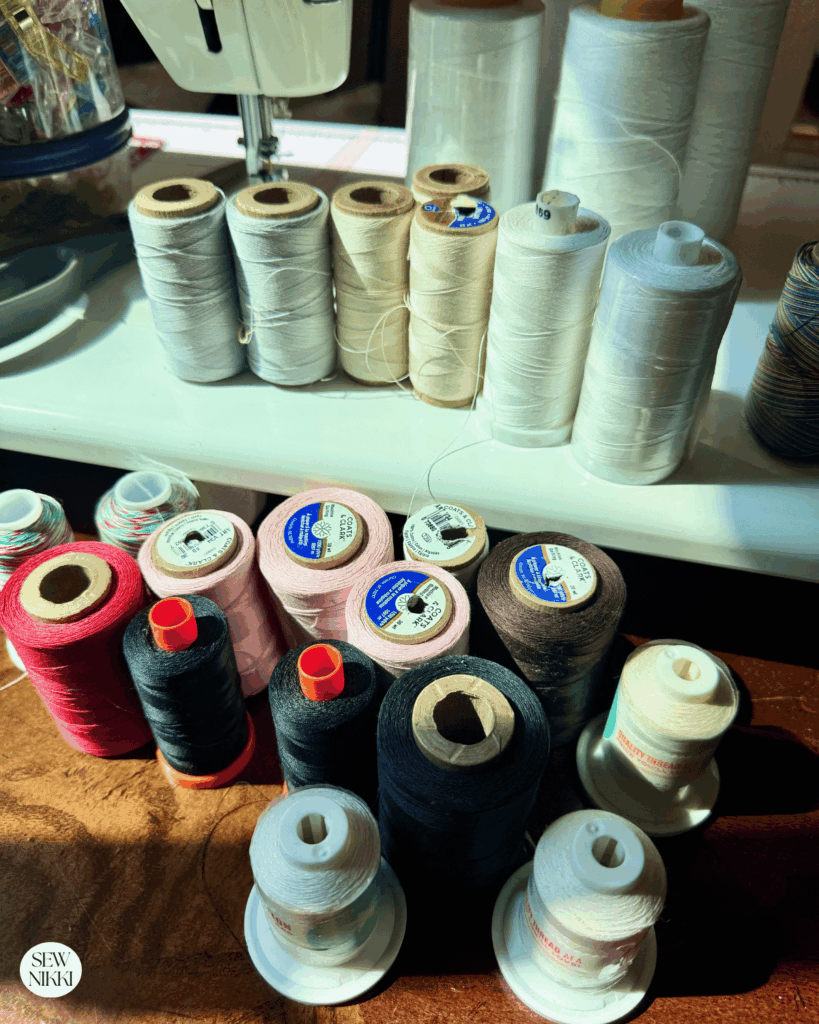
You can own 60 spools of thread for a wide variety of color choices.
Or you can keep it simple.
I quilt almost everything using 100% cotton quilting thread in three main colors:
- White
- Light gray
- Multi-colored (variegated color)
- Light beige
That’s it.
No color matching meltdown required.
I’ve used all three colors for piecing and machine quilting on scrap quilts, my very first quilt, and all projects in between.
When machine quilting bright scrappy quilts, the multi-colored cotton thread has natural fibers and looks amazing with all colors. It’s my go to for colorful scrappy quilts.
White Thread for Quilting
White thread works beautifully on:
- Light fabrics and backgrounds
- Low-volume quilts
- Modern designs with white fabric
- Baby quilts
If your quilt top has a white or very light background, white thread blends better than most people expect even over prints.
After washing, white thread softens into the quilt and becomes part of the texture.
Light Gray Thread (The One That Goes With Everything)
If you’re asking:
What color thread goes with everything?
The answer is light gray.
A medium value gray blends across:
- Lights
- Medium tones
- Many darker fabrics
- Busy prints
It doesn’t scream.
Doesn’t disappear completely.
It just works.
If I can’t decide in 60 seconds, I use light gray (dove gray).
Variegated Thread
Variegated thread is perfect for:
- Scrappy quilts
- Patchwork with lots of color changes
- Simple straight line quilting
- Edge to edge quilting
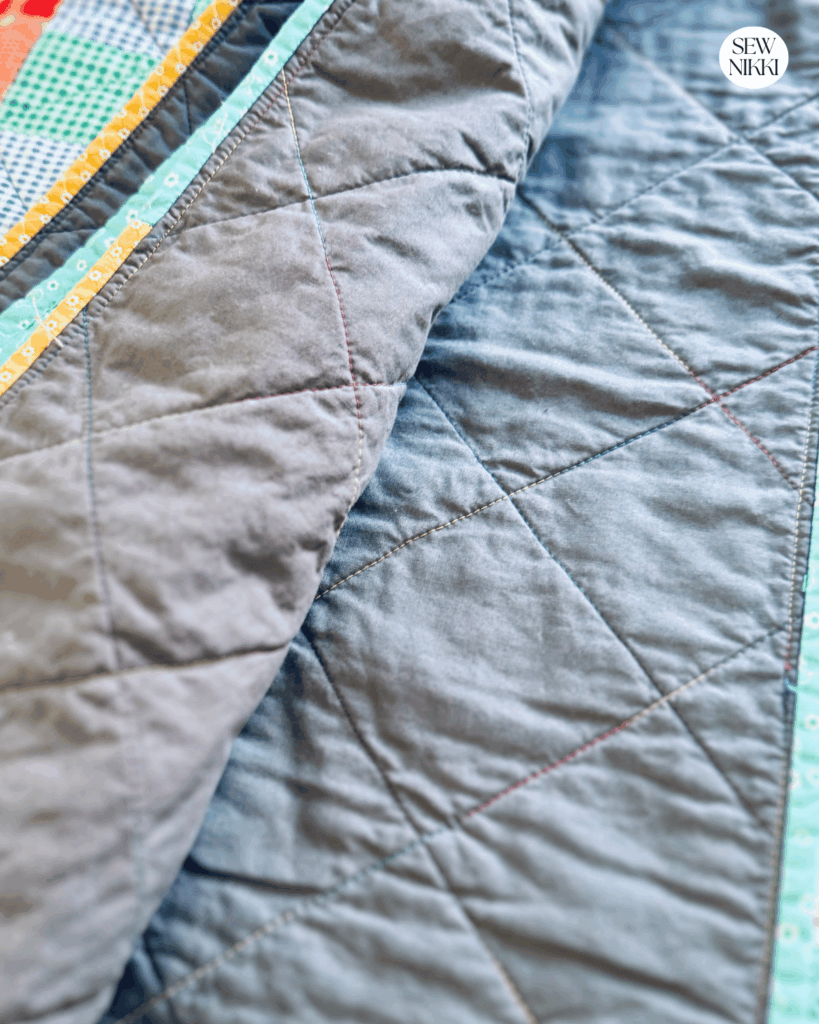
The color changes distract the eye, so no single shade stands out too much. It adds movement without requiring perfect matching. My favorite is Coats & Clark Teaberries pictured in my Checkerboard finished quilt below.
Cotton vs. Polyester Thread for Quilting
There are quilters who recommend polyester thread because:
- It sheds less than cotton
- It produces less lint
- It leaves less fuzz around your needle and presser foot
- It’s slightly stronger
All of that is true.
If you want a detailed fiber comparison, Superior Threads has a helpful breakdown explaining thread types and performance differences.
But here’s where I land:
I stick with 100% cotton quilting thread, the best thread in my opinion for me I use cotton fabrics, cotton thread of machine piecing and cotton thread for machine or hand quilting.
Why?
Because I’m quilting cotton fabric with cotton batting most of the time. Cotton thread:
- Has a soft, matte finish
- Blends naturally into cotton fabric
- Gives a classic look
- Ages beautifully
Polyester can have a slight sheen, which can highlight quilting lines more than you intended.
Neither is wrong. It’s about the finish you want.
Should Thread Color Be Lighter or Darker Than Fabric?
If your goal is blending, the real rule is this:
Match value, not exact color.
High contrast = quilting stands out.
Low contrast = quilting blends in.
If your fabric is very light:
- Choose white or very light gray.
If your fabric is very dark:
- Choose a medium gray or slightly lighter tone if you want subtle blending.
When in doubt, choose a medium neutral like dove gray. It splits the difference and avoids harsh contrast.
What Are the Top 3 Most Popular Thread Colors for Quilting?
Across quilting communities, the most commonly used thread colors are:
- White
- Gray (especially dove gray)
- Cream or off white
Black is popular too, but it’s high contrast and more specific.
White, gray, and cream are the true everyday workhorses.
What Thread Color Shows the Least on a Quilt?
If your goal is “least noticeable quilting,” choose:
- Medium gray
- Light taupe
- Soft off white
Thread stands out most when there’s high contrast in value not necessarily color.
If you want quilting texture to be subtle and soft, avoid extreme contrast.
How Do I Choose the Right Thread Color?
Here’s the practical system that actually works.
Step 1: Decide — Blend or Highlight?
Do you want the quilting to:
- Disappear into texture? → Blend.
- Be visible and defined? → Slight contrast.
Step 2: Identify the Dominant Fabric
Is there:
- A clear background color?
- A dominant neutral?
- A scrappy mix with no leader?
If there’s a strong background, blend with that.
If it’s scrappy chaos (the good kind), use gray.
Step 3: Lay the Thread Across the Quilt
Place the spool on the quilt top.
Step back 3–4 feet.
If it jumps out, it’s high contrast.
If it quietly settles in, it blends.
Step 4: Stop Overthinking
After washing and drying, subtle differences soften into texture.
Perfectionism slows quilters down more than thread color ever will.
Should Top Thread and Bobbin Thread Match?
Top thread and bobbin thread do not have to match.
Technically, you can use one color on top and a different color in the bobbin.
But here’s the part people don’t always say clearly:
If you use two different colors, your sewing machine tension needs to be dialed in perfectly — or the “wrong” color will start peeking through on the side it’s not supposed to.
If your top tension is slightly off, you may see:
- Bobbin thread pulling up to the top
- Top thread showing on the backing
- Tiny specks of contrast thread in your quilting lines
And once that happens across an entire quilt, it’s frustrating.
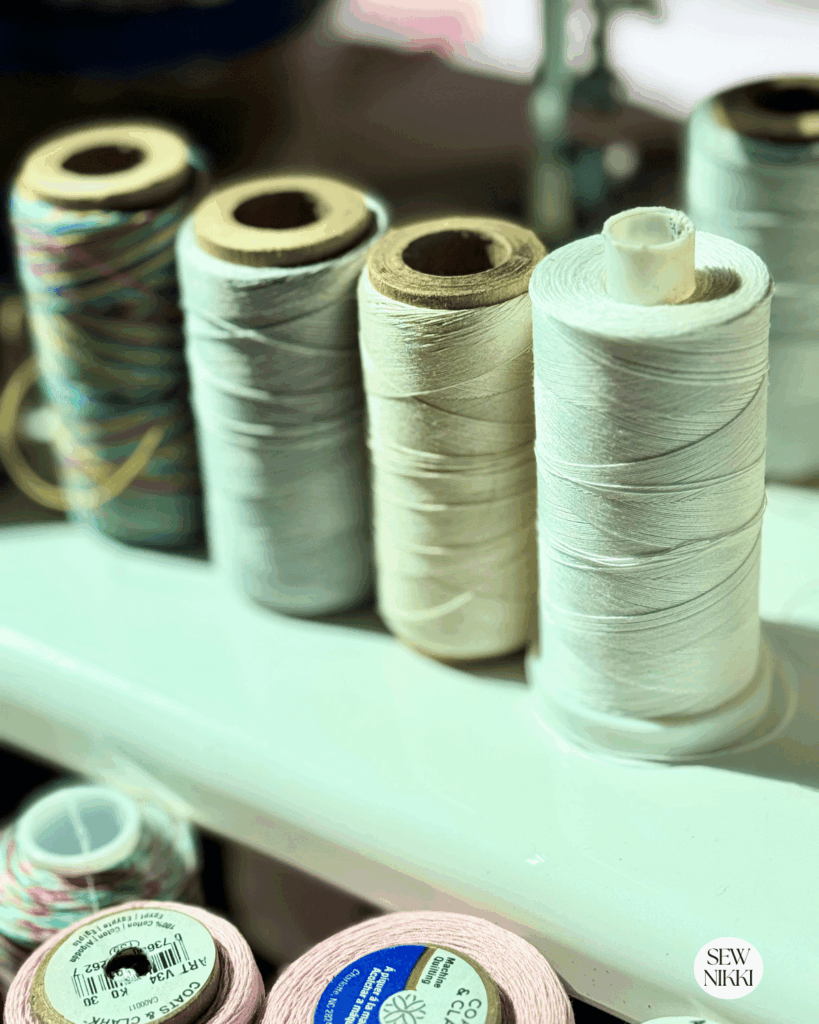
That’s exactly why I always use the same color for both the top and bobbin thread.
It eliminates:
- Tension stress
- Surprise color specks
- Constant checking
It’s simple. It’s clean. It removes a variable.
If you want to use different colors go for it. Just test on a quilt sandwich first and make sure your tension is balanced before quilting the real thing.
If you want less stress?
Use the same color in both.
Done.
Does Polyester Thread Ruin Cotton Quilts?
No.
Polyester thread will not ruin a cotton quilt.
Some quilters prefer fiber consistency (cotton with cotton). Others prefer polyester for durability and reduced lint.
Choose based on:
- Desired finish
- Lint tolerance
- Machine preference
- Personal aesthetic
What Weight Thread Is Best for Quilting?
Most quilting thread is:
- 40 wt
- 50 wt
I prefer 50 wt cotton for piecing and most quilting because it blends well and doesn’t create bulky seams.
If you want more visible quilting lines, use a slightly heavier thread like 40 wt.
Heavier thread = more definition.
The Best Cotton Quilting Thread Brands
If you prefer 100% cotton quilting thread, these brands consistently carry white, gray, and cream options.
Aurifil
- Extremely popular in the quilting world
- Smooth 50 wt cotton
- Wide range of neutrals including multiple gray tones
- Low lint for cotton
Where to buy:
- Local quilt shops
- Fat Quarter Shop
- Missouri Star Quilt Company
- Amazon
Gutermann (Cotton Line)
- Reliable and widely available
- Smooth finish
- Carries classic white and neutral tones
Where to buy:
- Hobby Lobby
- Amazon
Coats & Clark (Cotton Line)
- Budget friendly and widely available
- Good everyday cotton option
- Easy to find white, cream, and neutral grays
Where to buy:
- Walmart
- Yarnspirations
Superior Threads (King Tut Cotton)
- Slightly heavier cotton
- Rich color options
- Good neutral selection
Where to buy:
- Superior Threads directly
- Amazon
- Independent quilt shops
Internal Resources to Help You Quilt with Confidence
If you’re ready to use your thread instead of staring at it:
- Read my how to sew a quilt from start to finish for beginners
- Check out my guide to top 3 machine quilting designs on a home machine
- Practice with my free granny square quilt block pattern
The more you quilt, the less you stress about thread color.
Choosing the Perfect Thread Color for Quilting
Choosing the perfect thread color for quilting doesn’t require:
- A rainbow wall of spools
- A color theory degree
- Anxiety
Start with:
- White
- Dove gray
- Cream or a neutral variegated option
Use 100% cotton if you like soft and traditional.
Use polyester if you prefer less lint and added strength.
Test it. Step back. Trust your eye.
Once that quilt is washed, dried, crinkled, and loved?
No one is zooming in to critique your thread choice.
They’re wrapping up in it.
And that’s what actually matters.
If You’re New Here
I’m really glad you found your way here.
If you’re new to quilting, then welcome. The learning curve is fast, and yes, you’ll hit challenges. But I’ve got you.
Here’s where to go next:
- Free Pattern Index – all my free patterns in one place
- Digital, ad-free patterns – clean, printable, and beginner-friendly
- Handmade goodies – because sometimes you just want it finished
- Learn to Quilt Page – every step of making and finishing a quilt
My blog is built for the home sewist and quilter who wants to do it all themselves. With a nice but basic sewing machine and realistic expectations.
ABOUT SEW NIKKI
If this is your first time stopping by, welcome! Your place for free crochet, sewing and quilt patterns for beginner to intermediate skill levels. Want a digital pattern? We have those too! Plus tutorials to walk you through how to make each item from start to finish.
There is nothing wrong with having a dedicated piecing thread and a separate quilting thread. But there is also nothing wrong with choosing one neutral and running it from start to finish. Make life easy on yourself. Don’t overcomplicate things.
White, soft gray, and light beige are safe for piecing and quilting. Multi-colored thread works beautifully on bright, scrappy quilts. Pick one. Keep sewing. Finish the quilt. That’s the win.
Follow me on social media (Pinterest, Instagram, Facebook and Twitter) so you get notifications when I post new patterns and tutorials.
Looking for your next quilt project? Then head on over to my free “Pattern Index”. It’s a page dedicated to all of my free patterns separated by categories for crochet, sewing and quilting.
If you prefer an ad-free printable version, head over to my shop and browse the Digital Patterns. These are instant digital downloads you print yourself.
This post contains ads and affiliate links, which means I make a small commission at no extra cost to you. While the ads may seem annoying, it helps keep this blog going. See my full disclosure here.