Can You Make Quilts With a Regular Sewing Machine?
If you are new to quilting and want to know what machine to use, read this blog post. I’ll answer the number one question all new quilters have. Can you make quilts with a regular sewing machine? I’ll show you three popular machines and if you can make quilts with them. I’ll also give you helpful tips for making a large quilt on your regular sewing machine.
Your sewing machine is the most important piece of equipment, you can’t make a quilt without one unless you hand quilt and that takes forever. Most of us want a machine that can do every step of the quilting process.
If you are new here, I make my own quilts from start to finish. Which means I piece together the quilt top, make the quilt sandwich, machine quilt on my domestic sewing machine using straight lines quilting, then sewing on the binding.
MAKE SURE YOU CHECK THIS OUT!
After you read this post, make sure you also check out Learn How to Quilt for Absolute Beginners. It’s jam packed with information to make your first quilt. It also has links and resources that are so helpful when you’re first learning. There’s lots of free quilt patterns that are great for beginners and all skill levels too. So make sure you check this out, seriously don’t forget!
Make sure you grab a copy of my free Quilt Planning Journal. It’s filled with graph paper and note pages to help you design at least four quilt or sewing projects! Use it to jot down ideas, fabrics, patterns and inspiration all in one place. Or create your own patterns and share with others. Pin fabric swatches, photos of your finished quilts and enjoy your creative process!
Can You Make Quilts With a Home Sewing Machine?
This answer may surprise you but you can make a quilt on any regular sewing machine, even the most basic beginner machine. But you can’t make any size quilt, the smaller machines can’t handle large quilts. It’s too much stress on the machine and it’s motor. You will also have lots of issues with your thread, bobbin, puckering on the backing and skipped stitch or inconsistent stitches.
Pictured below are the four regular sewing machines I’ve used to show you I’ve tested a lot of regular machines. Bottom left was 30 years old and borrowed from a friend, I learned how to sew on it. Upper right is the Singer Start, first machine I purchased. Upper right was gifted to me by my best friend but I couldn’t find instructions and it had a million different stitches. Bottom right was my second purchase, I made a king size quilt on it.

Could I quilt on all of them? Yes, but not all quilt sizes. Did I enjoy quilting on them? Sadly the answer is no. It was very stressful quilting on all these machines until I invested in my current Juki. Now I’m not afraid of my machine constantly having issues or stressed when machine quilting. This current machine has a strong motor, an extension table and ample throat space. Game changer.
Beginner Machine
My first attempt was with the Singer Start. Trying to spend as little as possible when I started out, getting the basics because I didn’t even know if I would like this hobby. Does this sound familiar to you?
You can sew the quilt top on it but the motor and the overall machine cannot handle actual quilting. The small charm pack quilts that I did make on this machine were really bad. Puckering, stitches skipped, thread and bobbin issues, not good. Forget about large quilts, the throat space is small (around 5″). It also doesn’t have enough space to lay your work while quilting. Needs an extension table so really built for sewing and not quilting.
Heavy Duty Machine
My second machine with a Heavy Duty Singer with a small extension table. Again, all sewing machine brands have something similar to this Singer but are built the same. I used this to make two charm pack quilts, a bunch of them and it worked fine. Then I tried a king size quilt and it was torture.
The quilt barely fit through the throat space and the motor struggled so the stitches were awful and lots of skipped stitches. But the large quilt did fit and you can lower the feed dogs to free motion quilt if you like. This machine is better for smaller throw quilts and rolling up the quilt to fit through the machine.
It’s also a good machine when you upgrade and are new. If you want to quilt bad enough, this machine is your best bet. This would be my recommendation for new quilters just starting out. Throat space is just over 6″. I don’t think you can adjust the presser foot tension either on this machine and that’s an important feature for a quilting machine to have.
Quilting Machine
My current machine is a Juki TL-2000Qi and has a motor and extension table that can handle the weight of the quilt, any size quilt. It was made for quilting and is nice to use as long as you make sure there is no drag when you are actually quilting. The drag happens when the machine is not flush with your sewing table or when your quilt falls off the table on the left hand side when quilting.
You can free motion quilt by dropping the feed dogs or straight line machine quilt. You can use a walking foot or use the quilting foot to machine quilt on this machine. The Juki allows me to finish the entire quilt from start to finish and that works for me. The throat space is 8.5″ and works fine if you roll your quilt and work it through the space.
Sewing Machine Recap
Yes you can quilt on a regular sewing machine but not all machines can be used for large quilts. Motor strength, throat space and durability help determine what size projects from machine to machine.
Also, because you can do it doesn’t mean it will be easy on your machine or any fun. It’s very frustrating when you try to do more than the machine can handle because things will keep breaking on you. It’s probably not you but an inadequate machine.
Finally, the goal with machines is to spend what you can on something that will do the job and not be too stressful. Then save up until you can get a better, more enjoyable machine.
More Resources
Rachel Quilts – Her method for quilting on a regular sewing machine (video).
The Sewing Channel – Free motion quilting on a regular sewing machine (video).
Southern Charm Quilts (post) – Agrees you can quilt on any machine but it may not be worth it or enjoyable.
Read this post for more info on the best large throat sewing machine.
Tips for Quilting a Large Quilt
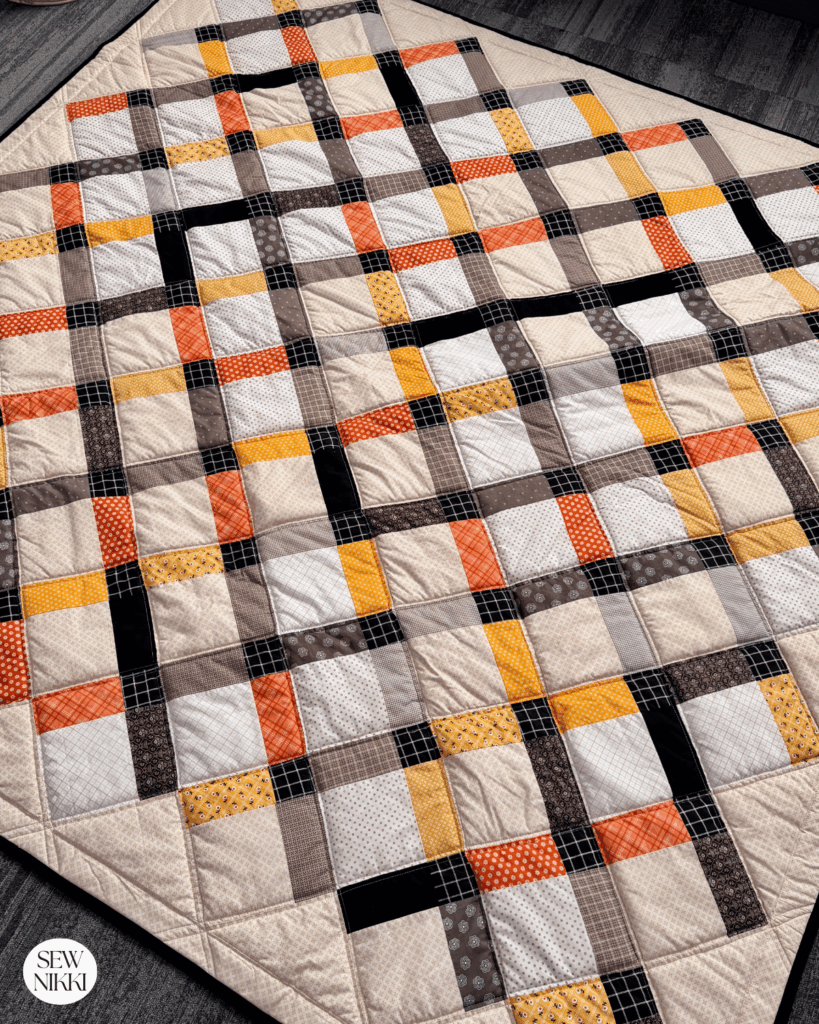
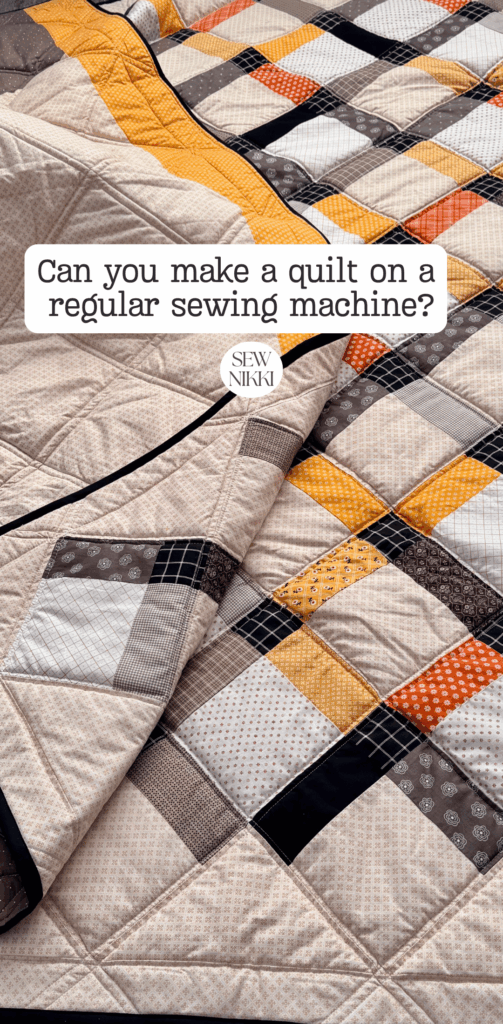
Batting, basting and presser foot will all effect your machine quilting. Your choices could make quilting easy or harder. Let me show you the choices I made for this finished queen size quilt, On Point Disappearing Nine Patch. Here are three things to consider when quilting a large quilt on your home sewing machine.
Batting Choice
My standard choice for batting is 100% cotton batting because that’s what everyone recommended when I learned how to quilt. Over the years I have used polyester or polyester blend batting a handful of times for one reason or another. But last year I made two quilts that turned out so great and both had polyester. They had more structure, were slightly thicker and really easy to machine quilt. So that’s what I used for this one.

I’m happy with this decision because the quilt is puffy and the back looks fantastic with the definition in the square quilt design due to the hi-loft polyester batting. Cotton batting doesn’t have this effect so I’m happy with my batting choice.
Basting Method
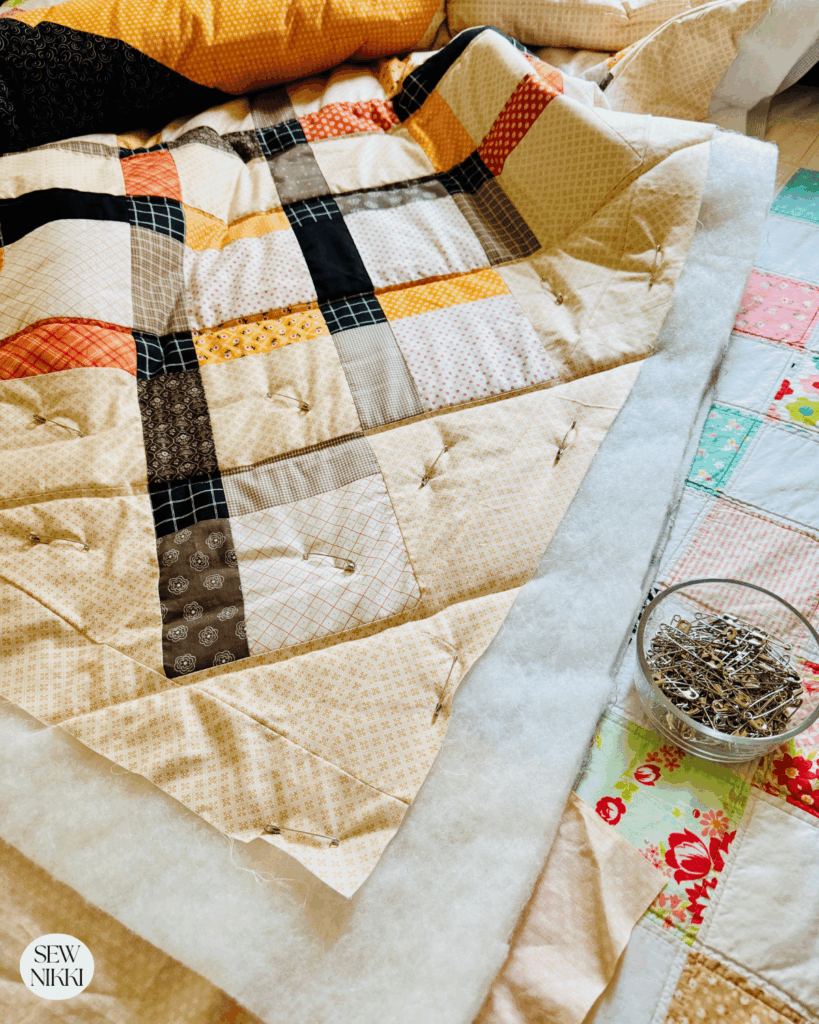
Instead of spray basting, I pinned this quilt using curved safety pins. I wanted to spray baste but needed to restock and didn’t want to wait. Finished this quilt was my plan for last weekend and I used what I had to accomplish this.
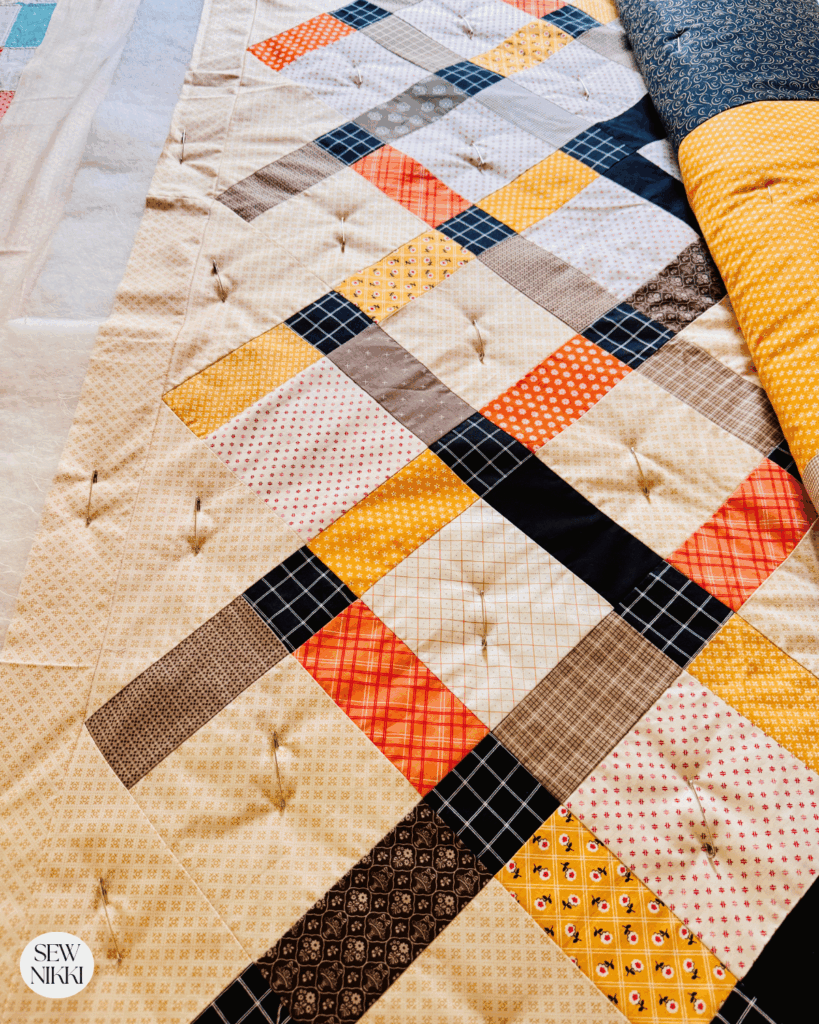
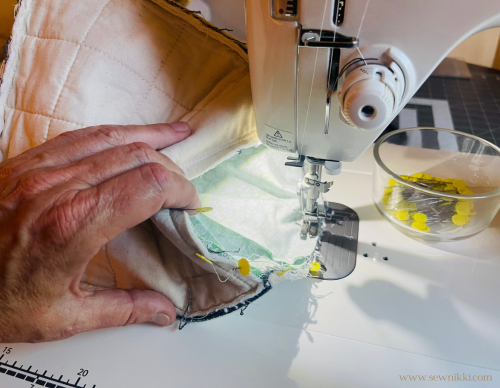
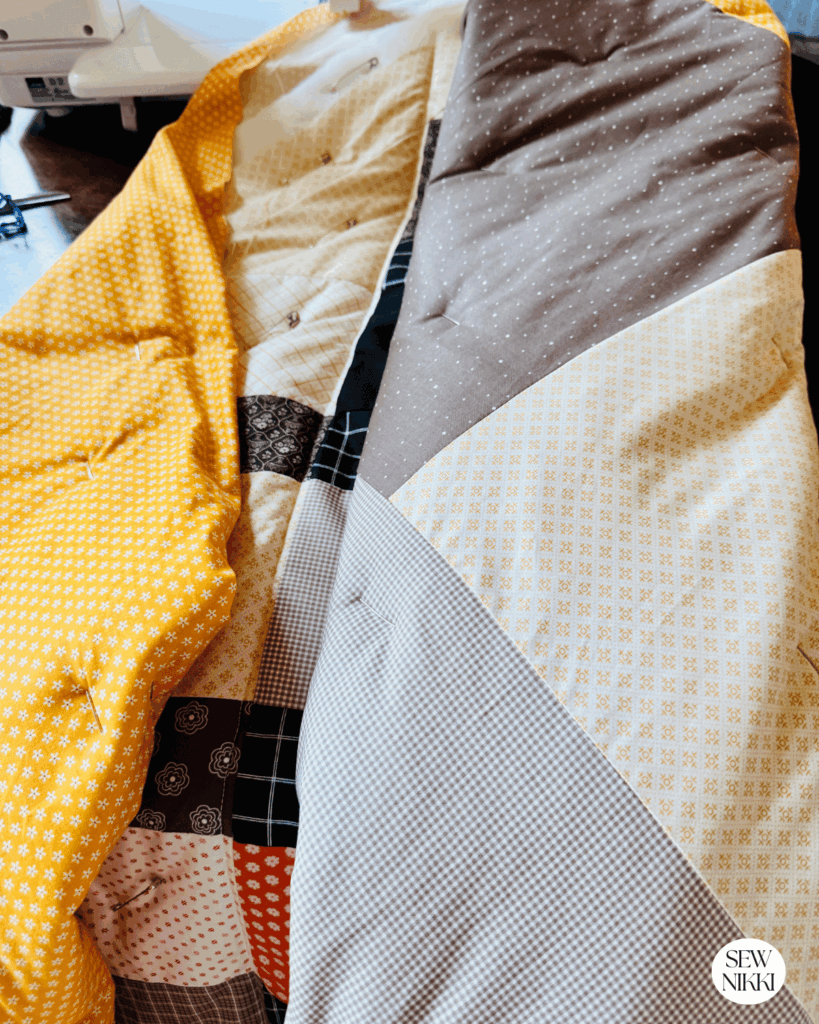
Pins make your quilt heavy and tends to drag your quilt down in several places: front, sides and back of machine. Each block had a pin in it so they were spaced out every 8″. Depending on your quilt size, that can be a lot of pins. The pins will drag even moving your quilt inside the throat space and over the needle plate. I struggled with machine quilting this especially since I was using high loft batting.
Here’s a great tip when you pin baste. Most of us always quilt horizontally and then vertically. So once you are done quilting in the first direction, remove the pins. Removing the pins when you are able makes it so much easier to handle. Remove the pins as soon as you finish quilting in one direction down both sides of that section. The fabric is securely sewn together and you don’t need the pins anymore. Why wait to pull them out, unpin as soon as you can.
Spray basting is much easier and lighting than pin basting so from now on my sewing room will always have a full can of 505 Spray. But if you are in a pinch, it’s nice to know you can use pins to keep things moving forward.
Presser Foot
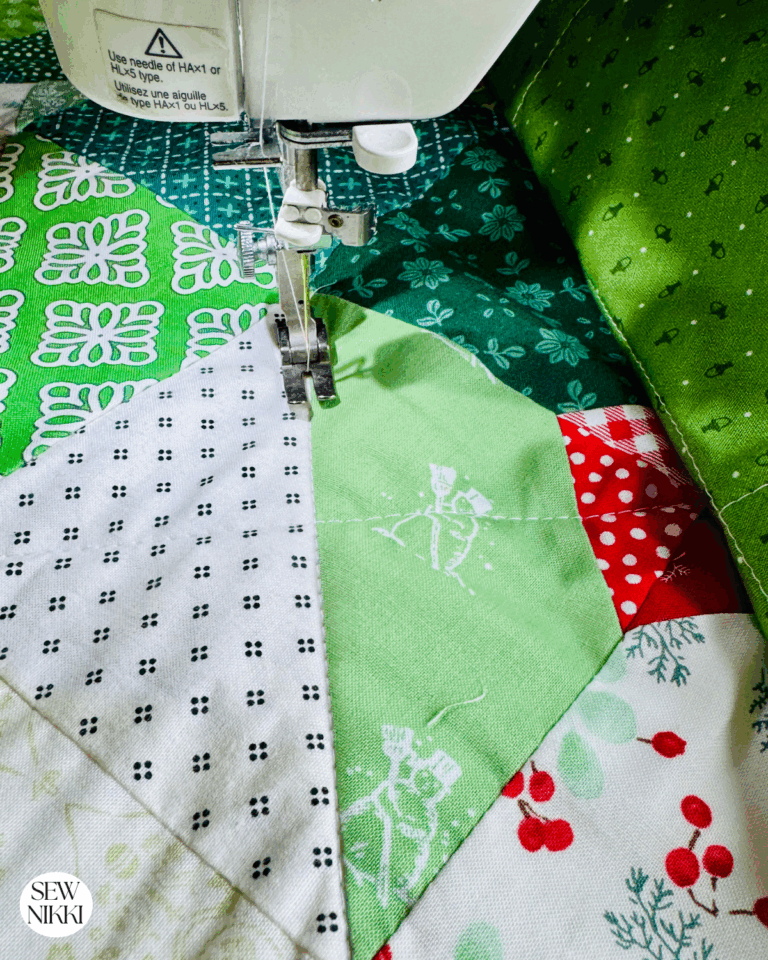
When you are ready to machine quilt, switch to your walking foot. This helps your machine move the fabric on top of and below your sewing needle. If you try to use your regular presser foot on most home sewing machines, it will be very hard to get nice even stitches and you might even get uneven backing with puckers and you don’t want that. And don’t forget to adjust your stitch length too.
Make sure you check for puckering on the back after you stich about 12″ or so and make adjustments if needed. Your straight stitch lines should be neat and even. Know your quilting plan and make sure you follow the batting instructions in regards to how much open space you can have between your machine quilting. Quilting gloves will make life easier to for moving the quilt through your machine.
Quilting Tips
Make sure you are using the right needle and it’s new. Always change it before quilting. The bulk of the quilt should be rolled up on both sides for easier maneuvering and it’s best to start in the middle of the quilt and work your way out, then flip and finish the other side going in the same direction.
If you are still having a hard time and your machine is struggling, try adjusting the presser foot and raise it. Quilts are thicker when you have all three layers to sew together. Use a good quality thread like Aurifil thread or a nice cotton. It won’t break as much like the less expensive threads. Before you know it, your first quilt will be done.
Save this pin for later!
Growing as a Quilter
Quilters should have a game plan of how you want it to look, thin cotton batting or puffier polyester batting and more like a comforter. Small adjustments can have a big impact. For example, scrappy pieced backing using left over fabric from quilt top instead of buying a new fabric for a solid backing. Finally, the way you are going to machine quilt in straight lines or lower the feed dogs and free motion quilt.
But the best part about this quilt is that I have a few years experience and have tried lots of different methods and techniques for each step of the quilt process. I know how a quilt looks with a certain type of batting and I know how to make something look puffier by the quilting design I select. And I definitely know that I love scrappy big pieced backing and even scrappy binding.
Finally, if you have a machine you can quilt on now but you are still stressed when quilting hang in there. Until you can upgrade machines just remember that the right batting, basting, tools, and presser foot can take away a lot of the struggle and make the process more enjoyable.
More Resources
Read my other post, how to quilt on a regular sewing machine for more tips and tricks for completing your quilt using your home machine.
If this is your first time here and you are new to quilting, start by checking out my Quilting 101 page. Then move onto the Quilting Tutorial page with full tutorials for each step in the quilt process. Finally, find a free quilt pattern or quilt project in The Pattern Index.
ABOUT SEW NIKKI
Welcome to Sew Nikki. Your place for free crochet, sewing and quilt patterns for beginner to intermediate skill levels. Want a digital pattern? We have those too! Plus tutorials to walk you through how to make each item from start to finish.
If you are working on a big quilt at home, small changes like these can make a regular machine feel capable of handling the size. This quilt is proof that you do not need special equipment to finish a project you love.
This post contains ads and affiliate links, which means I make a small commission at no extra cost to you. While the ads may seem annoying, it helps keep this blog going. See my full disclosure here.